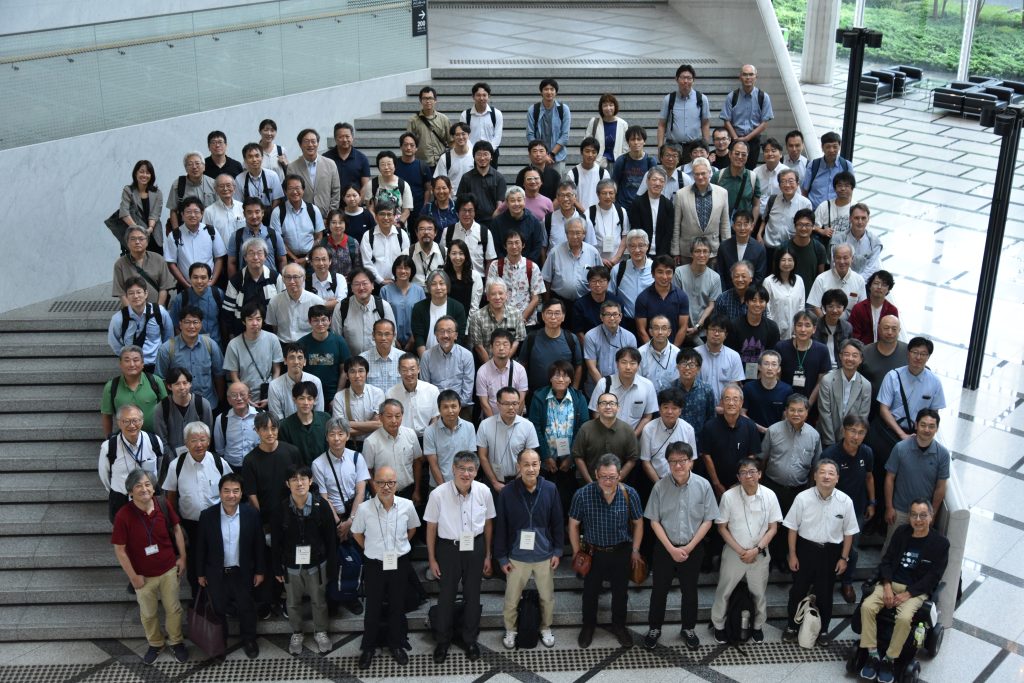
On July 28, KEK held the KEK Vision 2026 Open Symposium at the Tsukuba International Congress Center in Tsukuba, Ibaraki Prefecture. Approximately 170 researchers from universities across Japan and KEK attended in person, while more than 350 participants, including those from overseas, joined online. The symposium featured wide-ranging discussions on KEK Vision 2026, which will set out the future directions of research at KEK and serve as the foundation for a new research strategy.
KEK Vision: Envisioning KEK’s Future
The KEK Roadmap has long served as a guide to the organization’s research priorities. As research projects have grown in scale and complexity, however, it has become increasingly important to consider not only their scientific value but also their technical readiness, costs, and staffing requirements. A clearer process for selecting major projects is also needed, together with closer collaboration across KEK’s institutes, facilities, and research fields.
In this sense, KEK Vision is a collection of KEK’s ambitions for the future—a “wish list” of research themes that it hopes to turn into reality. A new Vision is expected to be developed every three years.
Collaboration Across Organizational and Disciplinary Boundaries
To help shape KEK Vision 2026, KEK invited ideas and proposals from across the research community through the end of June.
The symposium featured presentations summarizing the submissions received and highlighting some of the ideas that had emerged. The presentations were given by representatives of the International Center for Quantum-field Measurement Systems for Studies of the Universe and Particles (WPI-QUP) and KEK’s four institutes and laboratories: the Institute of Materials Structure Science, the Institute of Particle and Nuclear Studies, the Accelerator Laboratory, and the Applied Research Laboratory.
While many proposals originated within individual institutes and facilities, others brought together expertise from different parts of KEK and crossed traditional disciplinary and organizational boundaries. These presentations prompted a lively exchange of views on the research KEK should pursue and on new possibilities for collaboration across the organization.
The discussion also addressed the practical conditions needed to sustain research, including rising electricity and other operating costs, staff shortages, and aging facilities. Participants considered how projects could be reviewed and refined as they progress, helping KEK maintain the quality of its research while making the best use of limited resources.
KEK Vision 2026 to Be Finalized by the End of the Year
KEK will draw on the discussions at the symposium to prepare an interim summary, scheduled for publication in September. The research community will then be invited to provide further feedback, with the final KEK Vision 2026 expected to be completed in November or December 2026.
Once the Vision is complete, KEK’s institutes, facilities, and research centers will select the strongest candidates for major future projects from among the themes it contains. These will be projects considered ready to move toward implementation, including through government budget requests, and will be compiled into a shortlist.
The KEK Science Advisory Committee (SAC) will assess the scientific priorities of the shortlisted projects and incorporate its recommendations into the Future Project Plan (FPP). The Director General will then select projects from the FPP for more detailed consideration.
Each selected project will undergo a review by a dedicated committee. In addition to its scientific significance, the review will examine its technical readiness, the reliability of its cost estimates, and whether the necessary expertise and personnel can be secured. This process is intended to provide a thorough assessment of each project’s feasibility before it moves forward.
The symposium brought together researchers from within and outside KEK to explore a shared vision for the organization’s future. By encouraging discussion across institutional and disciplinary boundaries, it marked an important step toward a more integrated research strategy. KEK will continue to develop this strategy in consultation with the wider research community.