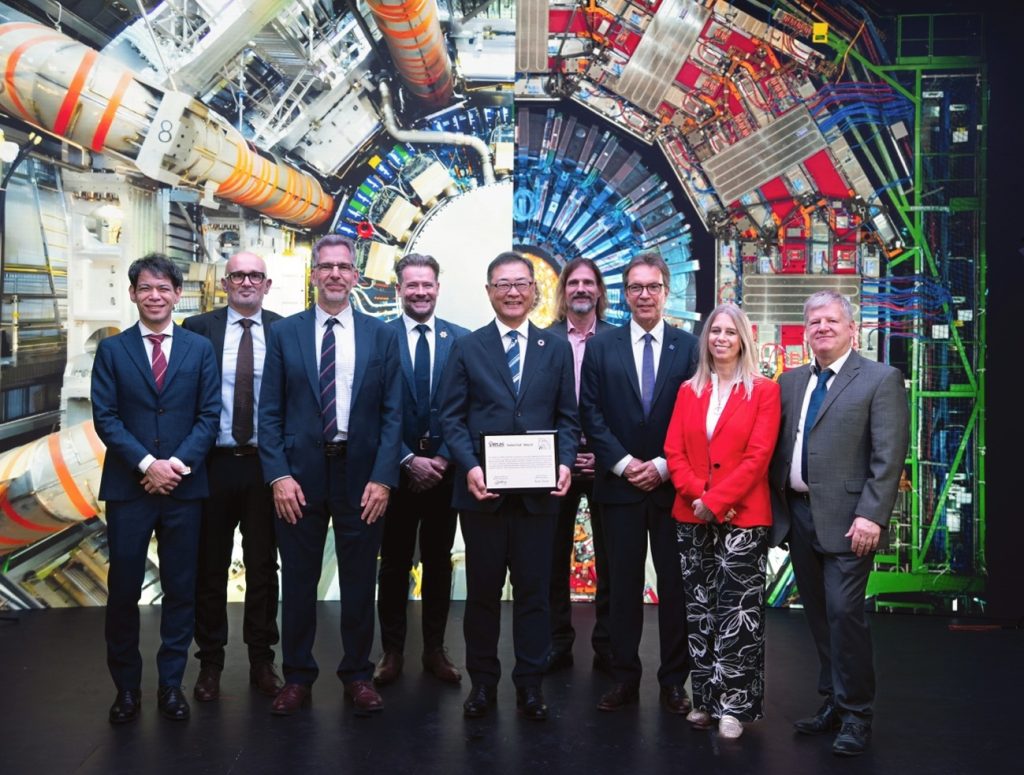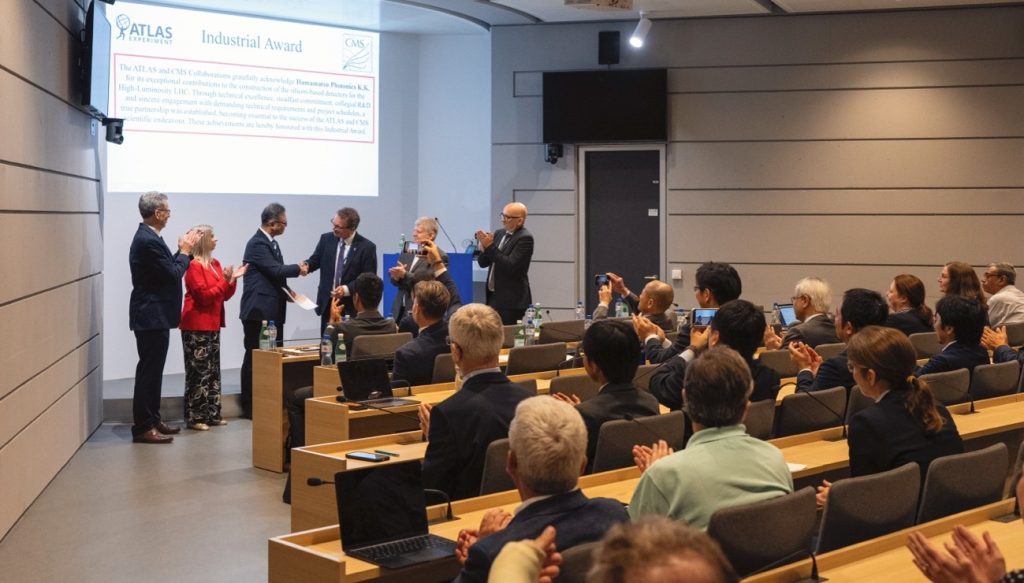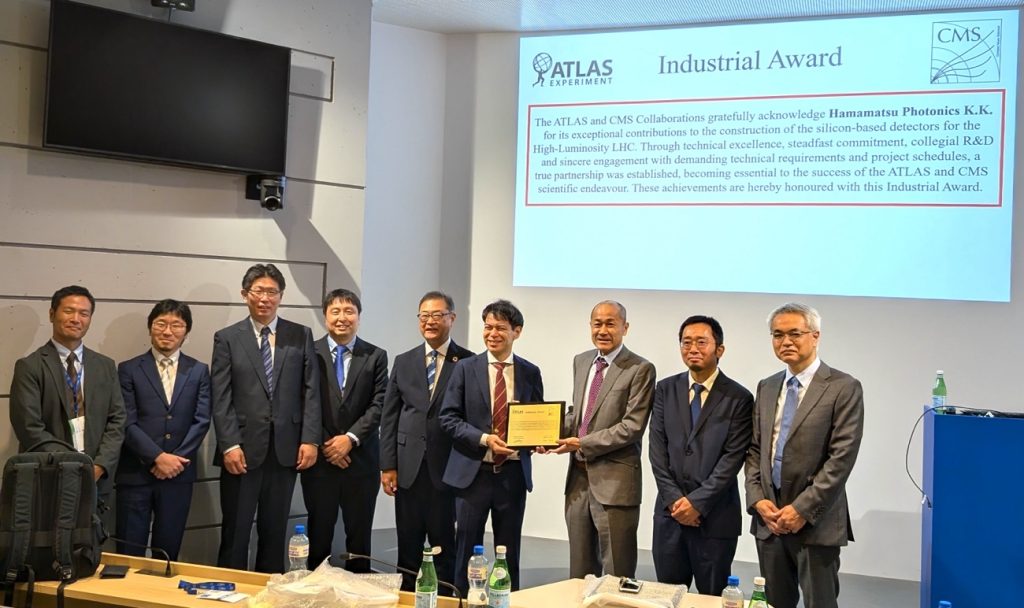
KEK acts as the principal institution for the Japanese group in the ATLAS experiment, one of the four major experiments at the Large Hadron Collider (LHC) at CERN. While advancing research within the ATLAS experiment, KEK has also partnered with Japanese companies to lead the R&D of next generation detectors for the High-Luminosity LHC (HL-LHC) project.
In recognition of these efforts, Hamamatsu Photonics — a long-time partner of KEK — has been presented with the ATLAS–CMS Industrial Award. This prestigious honor highlights the company’s outstanding contribution to the development and manufacturing high-performance silicon sensor technologies.
KEK has played an important role in the ATLAS experiment through the development and construction of key detector subsystems, including the inner tracking detector, the superconducting solenoid magnet, the muon trigger detector, and its readout electronics. Currently, in collaboration with universities and institutes across Japan, KEK is leading the construction of next-generation detectors designed to meet the unprecedented performance requirements of the HL-LHC.
The HL-LHC will push the frontiers of physics by producing an average of 140 proton–proton collisions every 25 nanoseconds. To achieve the precision “vision” (resolving power) needed to study rare processes and the detailed properties of the Higgs boson, the detector must resolve and precisely measure the massive influx of charged particles. Crucial to this is the semiconductor pixel sensor located nearest to the collision point; these sensors require a 50-micrometer pitch and must remain resilient even under extremely harsh radiation environment. Furthermore, the “bump-bonding” process used to connect these sensors to readout ASICs leaves virtually no room for misalignment, as its quality directly dictates the overall performance and reliability of the detector.
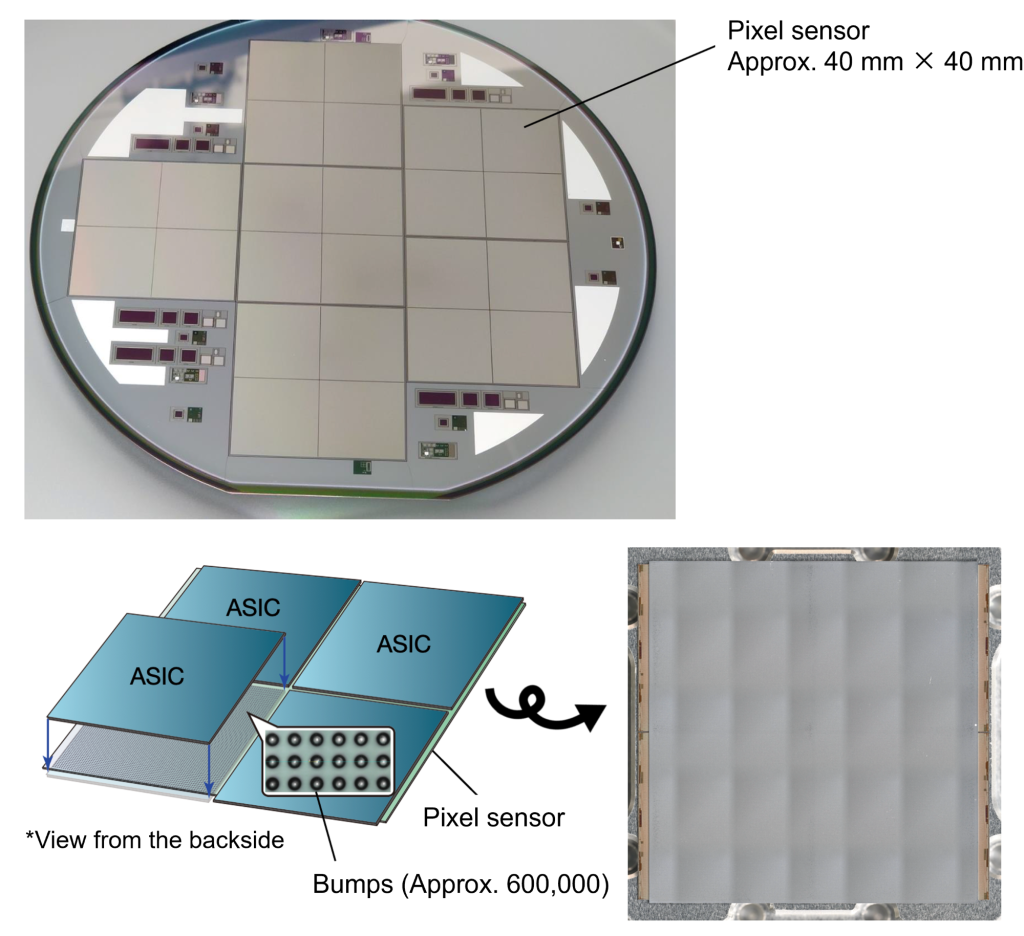
Meanwhile, covering the vast tracking area further from the collision point requires large-scale silicon strip sensors that must be produced in high volume with consistent quality. These advanced technologies are vital not only for ATLAS but also for the CMS experiment.
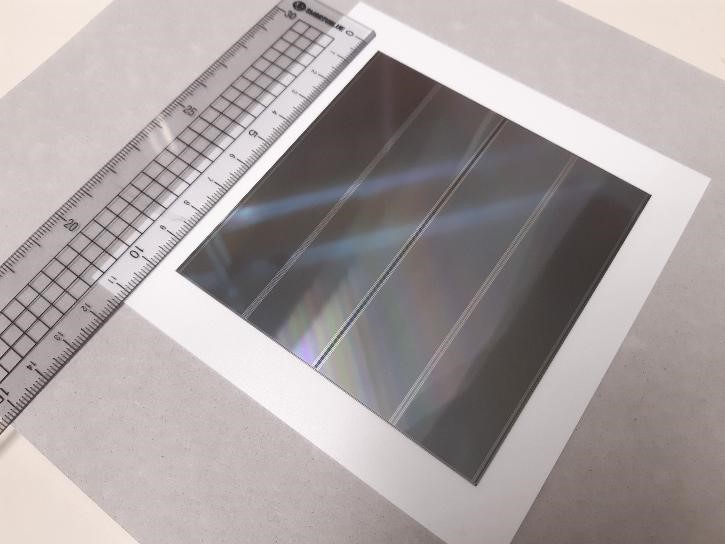
KEK has collaborated with Hamamatsu Photonics for many years to develop these cutting-edge detector technologies, with the company’s high-quality silicon sensors serving as a fundamental pillar of the project.
The success of this partnership is evident in the scale of production: while the current ATLAS tracking detector utilizes more than 60 square meters of silicon sensors, the HL-LHC upgrade will require nearly 180 square meters. Most of these sensors are manufactured by Hamamatsu Photonics.
The collaboration is also driving the development of future detector technologies, such as the Low Gain Avalanche Detector (LGAD). This technology can measure the timing of a particle’s passage with extreme precision — down to few tens of picoseconds. Such ambitious R&D is essential for the evolution of particle physics, and through these ongoing challenges, the technologies that push the frontiers of human knowledge are being refined. These achievements further demonstrate the excellence of Japanese technology to the world.
This award stands as a testament to the fact that the advanced detector development and manufacturing driven by KEK, universities, and Japanese industry are recognized internationally as a vital technological foundation. The collaborative framework established through years of R&D — characterized by sophisticated technology, quality control, and large-scale production — serves as a model of future large-scale international scientific projects.
Moving forward, KEK will continue to promote the research and development of cutting-edge technologies that support accelerator science and particle physics through continued partnership with industry.