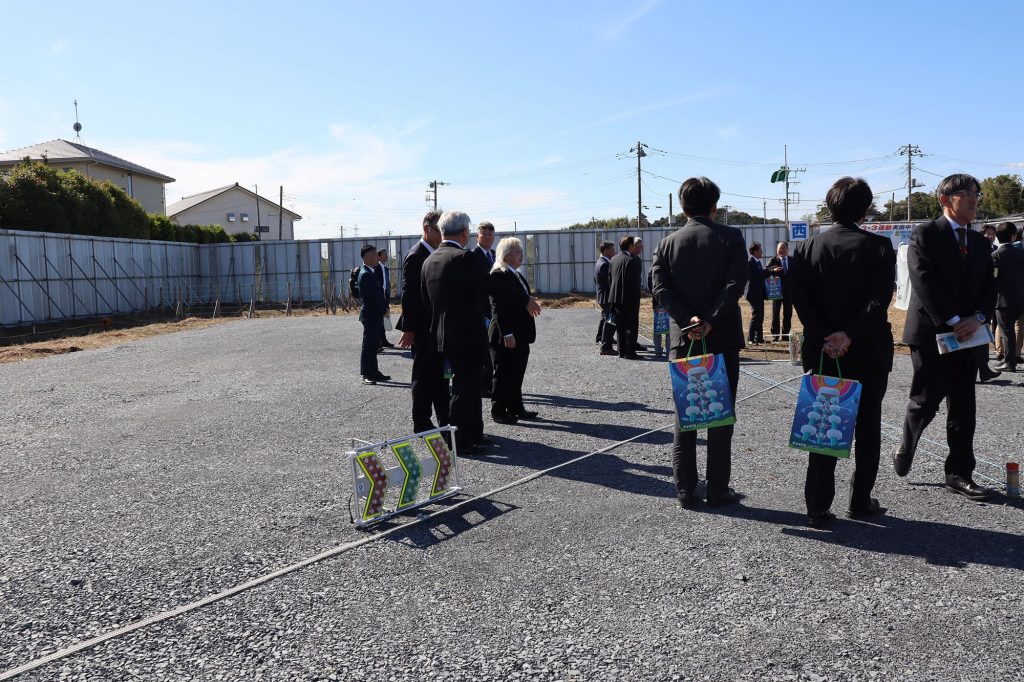
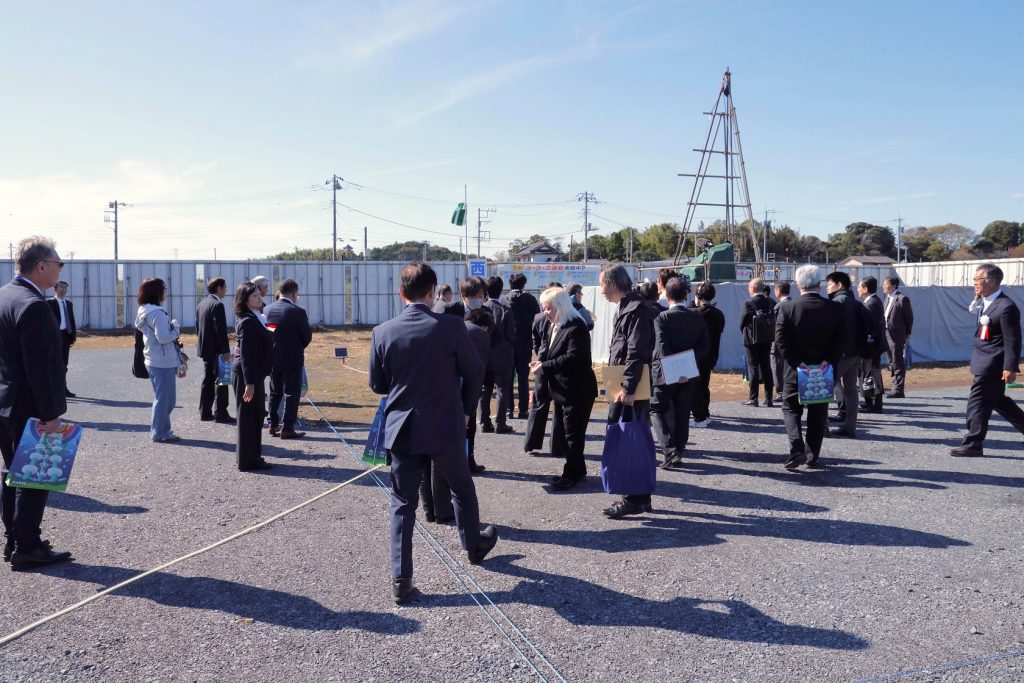
On November 4th, KEK held a groundbreaking ceremony for Intermediate Water Cherenkov Detector (IWCD) facility in Tokai, Ibaraki. IWCD is one of the significant devices used in Hyper-Kamiokande (HK) Project, an international collaborative experiment that aims to uncover the properties of neutrinos.
An artificial neutrino beam has been produced at Japan Proton Accelerator Research Complex (J-PARC), which is jointly operated by KEK and Japan Atomic Energy Agency in Tokai. Institute for Cosmic Ray Research (ICRR) at the University of Tokyo is currently constructing the Hyper-Kamiokande detector in Kamioka, Hida in Gifu Prefecture, 295 km away from Tokai. Observing the neutrino beams from J-PARC with this new detector in Kamioka is one of the pillars of the HK experiments.
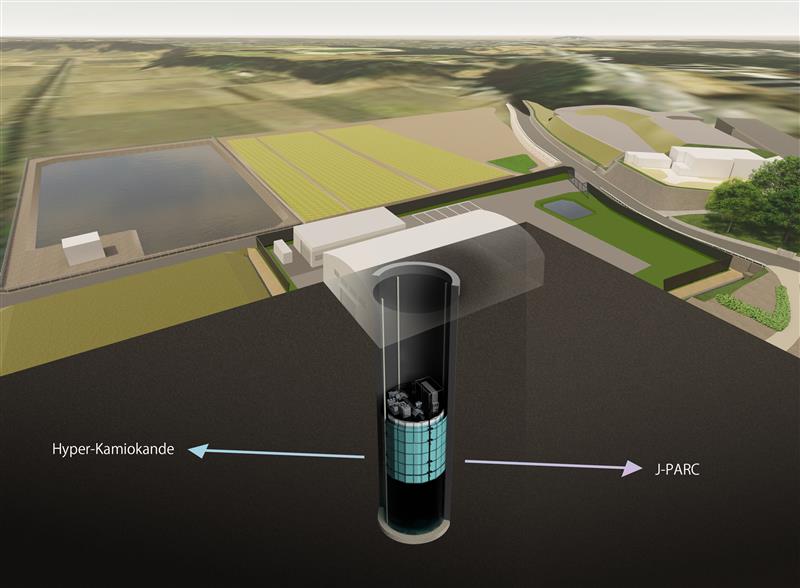
The groundbreaking ceremony was held at the site where IWCD will be installed. Expressing his deep gratitude to those involved, including the landowners of the construction site and local residents in Tokai, Asai Shoji, KEK Director General, explained the significance of the construction, saying, “By comparing measurements in Kamioka with those in Tokai, discoveries that would have taken 10 years in the past will be possible in just five years. IWCD is such a meaningful detector. When the news, like ‘The origin of matter in the universe has been discovered!’ comes around the 2030s, people will probably remember this ceremony today.”
Nakadaira Takeshi, Professor of KEK Institute of Particle and Nuclear Studies, stated an overview of IWCD. He said, “It is the first movable detector in the world. I hope that this unique facility capable of high-quality measurements will attract researchers from oversea as well as from Japan,” with his wish that this IWCD construction would give influences on even more active research activities in the fields of space and elementary particles.
Greetings from the guests followed.
Yamada Osamu, Village Mayor of Tokai, while touching the history of Tokai and nuclear power, mentioned how the local people’s understanding toward cutting-edge studies led to the groundbreaking that day. In addition, he introduced the exchange program between children in Tokai and Kamioka town and emphasized, “The children are proud that an international project is going on at J-PARC and Kamiokande. I believe that this project is very significant as well in terms of cultivating talent who will foster an affinity for science through this experience and succeed in this field in the future.”
Tawara Koji, Director of University Research Facilitation Division, Ministry of Education, Culture, Sports, Science and Technology (MEXT), said, “This project is a great opportunity for Japan to fully demonstrate its research capabilities. I’m already excited to imagine what would be discovered around 2030. MEXT would like to work together to ensure this project progresses smoothly.”
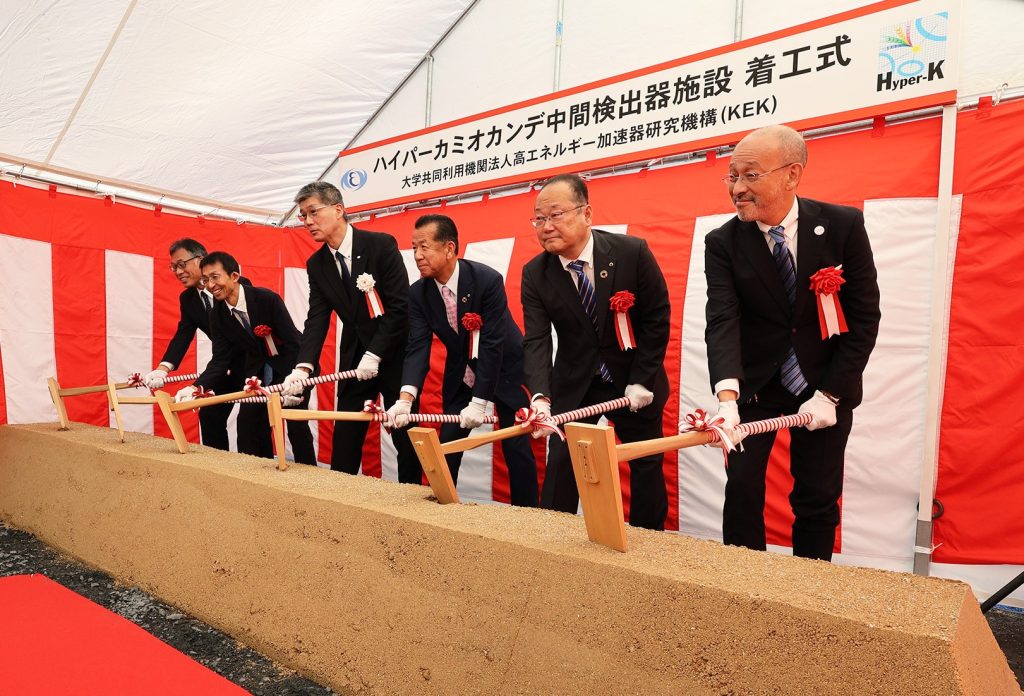
Finally in the ceremony, Yuji Yoshida, the contractor and President of Morigumi Co., Ltd., expressed his enthusiasm for the project, pledging, ” I believe that it brings all wisdom of scientists not only in Japan but also all over the world and it is the greatest honor in the history and future of our company to be able to take on a part of role in this major project. To accomplish this construction, we will value harmony with the local community, give thorough consideration to the environment, and strive to operate the site safely and securely.”
A line was drawn from J-PARC toward Hyper-Kamiokande at the ceremony venue, and ropes were used to indicate the locations of the detector’s stakes and buildings to be constructed.
Ropes indicating the location of the detector stakes and buildings