
High Energy Accelerator Research Organization (KEK)
J-PARC Center
Executuve Summary
Question
The muon is an unstable elementary particle with a short lifetime of approximately two microseconds. During this brief window, it acts as a probe of its environment. When injected into liquid water, the muon attempts to sense the surrounding molecules through their magnetic fields; however, because these molecules move on timescales significantly shorter than a microsecond, the muon detects nothing. In contrast, when the water freezes, the muon instantly detects the magnetic fields of the water molecules, causing its spin orientation to undergo rapid relaxation. While this phenomenon has been observed since muon research started over five decades ago, no one had been able to accurately explain the underlying mechanism—nor had anyone realized that the key to this mystery lay in the system’s quantum nature.
Findings
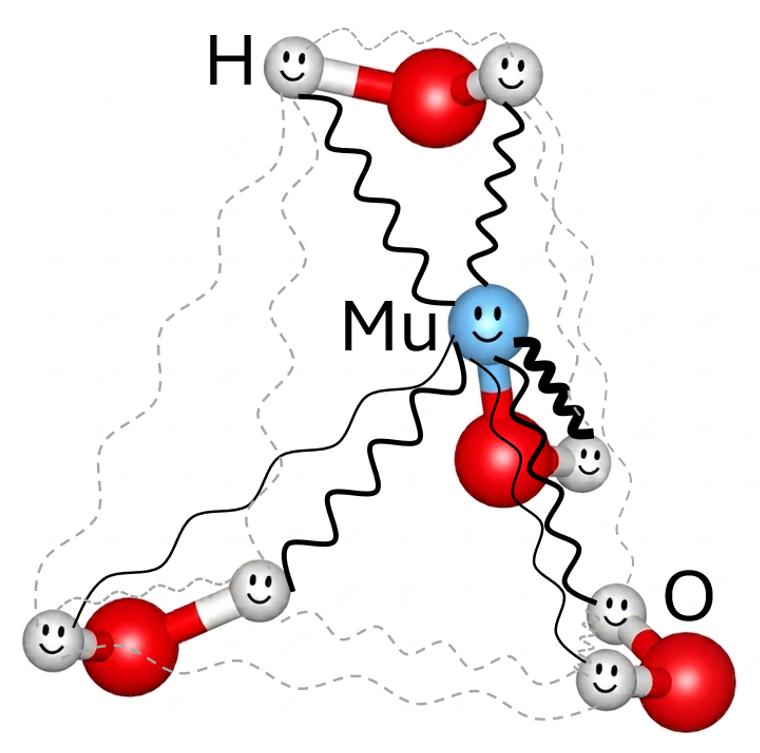
Using a muon beam at J-PARC (Japan Proton Accelerator Research Complex), we observed ‘quantum coherence’—a state in which quantum wave properties are preserved—in muon spins within ice. In this state, a muon replaces a hydrogen (proton) atom in a water molecule to form a unique molecule called MuOH. By modeling the magnetic field that the muon spin perceives from the surrounding nuclear spins of hydrogen atoms, we have successfully explained previously mysterious signal variations, including the spin depolarization caused by magnetic field fluctuations and the observed shifts in rotation frequency.
Meaning
We have demonstrated the fundamental quantum effects in water—a ubiquitous substance in our world. As water serves as a foundational molecule across physics, chemistry, and biology, this discovery provides a new perspective that could impact a wide range of scientific fields.
Overview
We have discovered a new quantum mechanism within ice. When muons are injected into water, they replace one of the hydrogen atoms in a water molecule (H2O) to form a unique species known as “MuOH”. Our findings reveal that the muon spin within this molecule exhibits ‘quantum coherence’—a state in which its quantum waves synchronize with the nuclear spins of surrounding hydrogen atoms. This interaction accounts for the signal variations observed in ice-based muon experiments, resolving a mystery that has persisted for decades.
This study was published online in Physical Review B on July 7, 2026.
Please refer to the press release for details.
Contact
High Energy Accelerator Research Organization (KEK)
e-mail: press@kek.jp