
High Energy Accelerator Research Organization (KEK)
Institute of Science Tokyo
Executive Summary
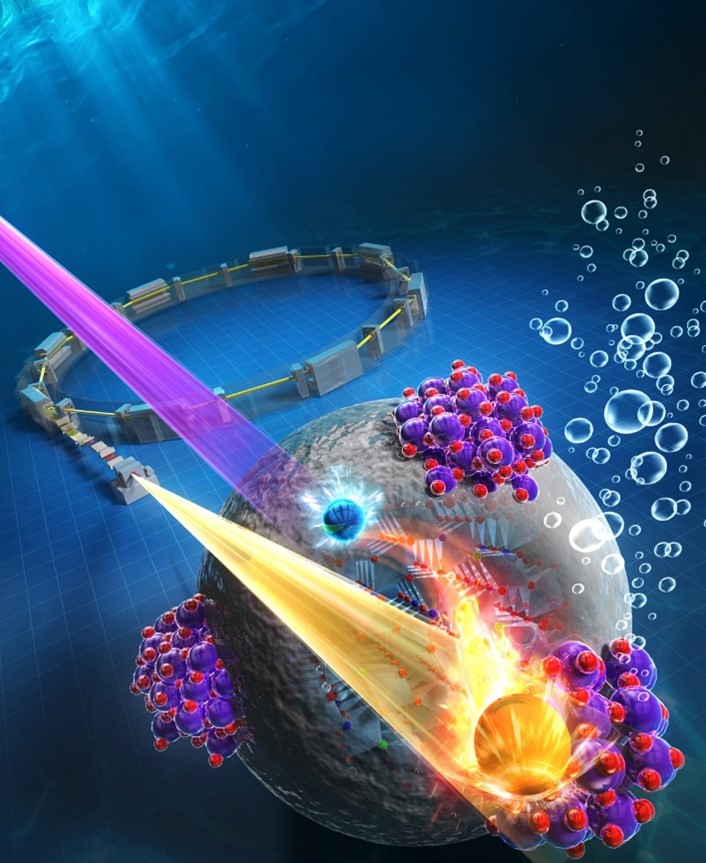
- We directly observed, using time-resolved X-ray absorption spectroscopy, photoexcited hole-injection dynamics from a semiconductor photocatalyst (titanium dioxide) to a cocatalyst (iridium oxide), which drive the light-induced water-oxidation reaction.
- When nitrogen- and fluorine-co-doped titanium dioxide was used, the hole lifetime in the iridium oxide cocatalyst was extended by approximately 16-fold on the nanosecond timescale (1 ns = one billionth of a second). This prolonged lifetime was correlated with enhanced water-oxidation activity.
- While N,F co-doping was originally established as a treatment for imparting visible-light responsiveness to semiconductor photocatalysts, this study experimentally revealed that the same co-doping treatment also acts as a “latch” at the semiconductor/cocatalyst interface, suppressing the back-transfer of holes from the cocatalyst to the semiconductor.
Summary
The High Energy Accelerator Research Organization (KEK) and the Institute of Science Tokyo have succeeded in directly observing the photoexcited hole-injection dynamics — which drive the light-induced water-oxidation reaction — from a semiconductor photocatalyst to a cocatalyst, using time-resolved X-ray absorption spectroscopy at the Photon Factory Advanced Ring (PF-AR), KEK’s synchrotron radiation facility.
In photocatalytic water splitting, it is well known that loading a small amount of metal oxide called a “cocatalyst” onto a semiconductor photocatalyst alters the dynamics of photogenerated charge carriers and thereby enhances activity. However, charge-carrier dynamics within the cocatalyst itself had remained unclear due to limitations of conventional experimental techniques.
In this study, we focused on iridium oxide (IrOx) cocatalysts loaded on nitrogen- and fluorine-co-doped titanium dioxide (IrOx/TiO2:N,F), and by exploiting the element selectivity of X-rays, we succeeded in extracting the behavior of holes within the IrOx under ultraviolet (UV) light excitation. We further demonstrated that longer hole lifetimes in the cocatalyst correlate with higher water-oxidation activity.
Interestingly, although N,F co-doping was originally developed and used to render photocatalytic materials responsive to visible light, we found that this treatment also has another important effect — substantially extending the hole lifetime within the cocatalyst.
These results were obtained by a collaborative research group led by Researcher Tomoki Kanazawa (KEK Institute of Materials Structure Science), Associate Professor Shunsuke Nozawa (KEK), and Professor Kazuhiko Maeda (Institute of Science Tokyo). The experiments were carried out using the time-resolved X-ray experimental station AR-NW14A at KEK PF-AR.
These findings were published online in ACS Catalysis (American Chemical Society) on May 13, 2026.
Please refer to the press release for details.
Contact
High Energy Accelerator Research Organization (KEK)
e-mail: press@kek.jp