
Ibaraki University
High Energy Accelerator Research Organization
The Graduate University for Advanced Studies
A research group led by Associate Professor Hiromi Iinuma of the College of Science, Ibaraki University, and Ryota Matsushita of the Graduate School of Science, The University of Tokyo, has achieved the world’s first experimental demonstration of beam storage in an ultracompact storage ring using a three-dimensional spiral injection scheme.
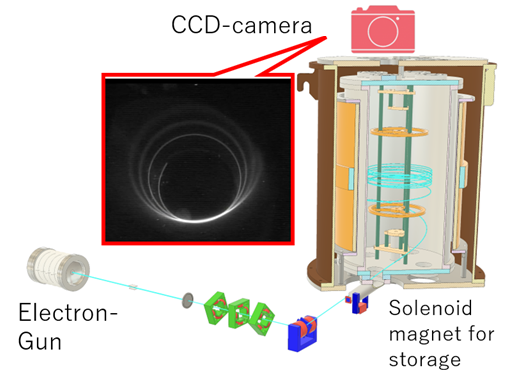
Precise measurements of spin precession in charged particles require particle beams to be stored stably for long periods in a highly uniform magnetic field. However, as storage rings become smaller, it becomes increasingly difficult to secure sufficient space for beam injection from outside the ring. To address this challenge, the research team developed a novel injection scheme that guides beams into the axisymmetric field of a solenoidal magnet, similar to those used in MRI systems, along a three-dimensional spiral trajectory.
Furthermore, the team experimentally demonstrated stable beam storage for more than 200 revolutions in a storage ring with a revolution period on the order of nanoseconds, using a pulsed magnetic kicker system. Such beam storage is extremely challenging with conventional injection schemes. This achievement represents an experimental demonstration of beam storage using the three-dimensional spiral injection scheme.
The three-dimensional spiral injection scheme demonstrated in this work is expected to contribute not only to next-generation compact storage-ring technologies, but also to the development of novel beam-control techniques in complex magnetic-field environments. Future work will focus on generalizing the concept to beam transport and storage design in arbitrary magnetic fields and exploring its application to next-generation accelerator technologies. This work was accepted for publication in Physical Review Letters (PRL) on May 21, 2026, and was published in open-access form on July 16, 2026.
Please refer to the website of Ibaraki University for details.
Contact
High Energy Accelerator Research Organization (KEK)
e-mail: press@kek.jp