
J-PARC Center
High Energy Accelerator Research Organization (KEK)
Japan Atomic Energy Agency (JAEA)
The University of Tokyo
Tokai National Higher Education and Research System, Nagoya University
RIKEN
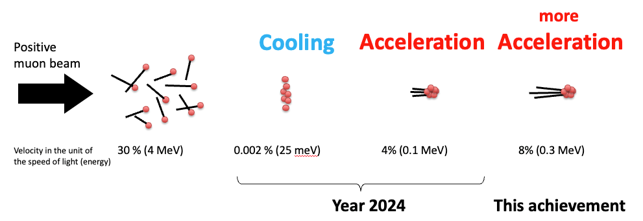
At the Materials and Life Science Experimental Facility (MLF) of the Japan Proton Accelerator Research Complex (J-PARC), muons were cooled from a kinetic energy of 4 MeV down to 25 meV (a reduction by a factor of about 160 million) and then accelerated to 0.3 MeV (approximately 8% of the speed of light) in the new experimental area dedicated to muon acceleration (Muon H2 Area). Compared with the world’s first demonstration of muon acceleration in 2024, this represents three times the energy and 200 times the intensity (approximately 10 muons per second). This achievement marks an important step toward the operation of the world’s only muon accelerator.
Overview
The muon is an elementary particle similar to the electron. Muons produced artificially with accelerators are used in a wide range of fields, including materials science, particle physics, and the transmission imaging of large structures. However, ordinary muon beams produced at accelerator facilities have widely spread directions and velocities, and cannot be accelerated as they are.
A research group of KEK, the Japan Atomic Energy Agency , Okayama University, Nagoya University, Kyushu University, Ibaraki University, and Niigata University achieved the world’s first demonstration of muon cooling and acceleration, using a method in which muons are first cooled to a nearly-at-rest state and then accelerated with a radio-frequency accelerating cavity (press release of May 2024, “World’s first cooling and acceleration of muon – The first muon accelerator finally coming to a reality –”). This result was featured on the cover of Physical Review Letters and was selected for the journal’s 2025 collection of notable papers, receiving high international recognition.
This time, a research group of the J-PARC Center, KEK, the Japan Atomic Energy Agency, the University of Tokyo, Nagoya University, and RIKEN carried out a muon cooling and radio-frequency acceleration experiment in June 2026 in the experimental area (H2 Area) of the dedicated muon beamline (H-Line), newly constructed at MLF for the muon g-2/EDM experiment, the transmission muon microscope, and the development of core technologies for artificial, transportable muon beams. As a result, muons were successfully accelerated to a kinetic energy of 0.3 MeV (approximately 8% of the speed of light). Compared with the 2024 demonstration (0.1 MeV, 0.05 muons per second), the group achieved three times the energy and 200 times the intensity (approximately 10 muons per second) in the area where the actual experiments will be performed. Because this achievement was obtained in the area where the actual experiments will be performed, the research has advanced significantly from the “demonstration” stage of muon acceleration to the “implementation” stage of producing beams for actual experiments. It marks an important step toward the operation of the world’s only muon accelerator. The group aims to achieve acceleration to 4 MeV (approximately 30% of the speed of light) around 2027–28, establishing the key technologies for future artificial, transportable muon beams. Ultimately, the muons will be accelerated to even higher energies (above 200 MeV, more than about 90% of the speed of light) for high-precision tests of the Standard Model of particle physics through precision measurements of the muon g-2 and EDM, as well as for applied research in materials science and engineering with the transmission muon microscope.
Please refer to the website of J-PARC for details.
Contact
High Energy Accelerator Research Organization (KEK)
e-mail: press@kek.jp