
Executive Summary
Mission
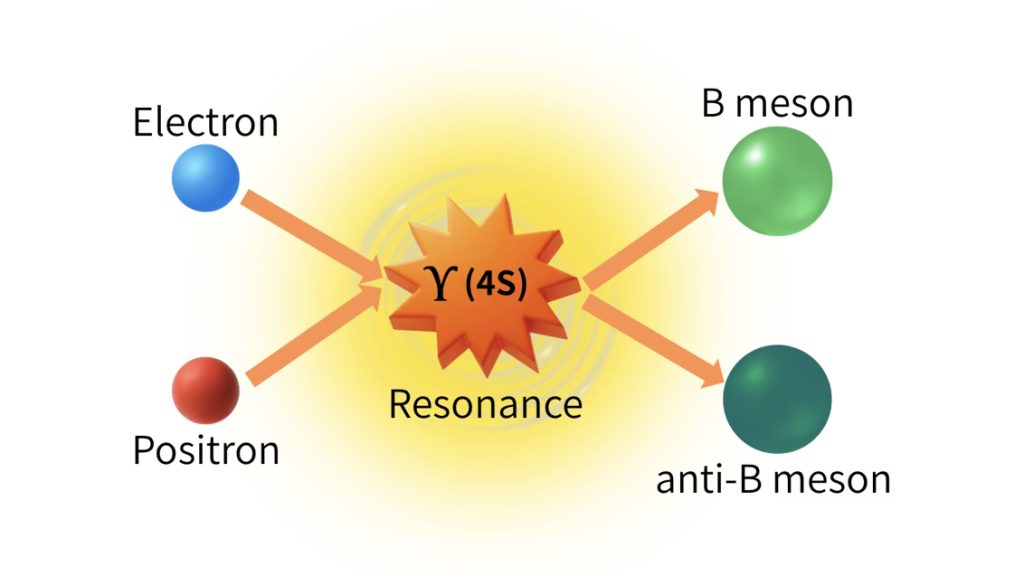
The Belle II experiment at the SuperKEKB accelerator, which is one of KEK’s flagship projects, accumulates a vast number of B meson events to search for new physics beyond the Standard Model. At SuperKEKB, B mesons are produced from electron-positron annihilation at the Υ(4S) (Upsilon-4S) resonance. To maximize this dataset, the project continuously pursues world-leading performance while overcoming various challenges.
Achievements
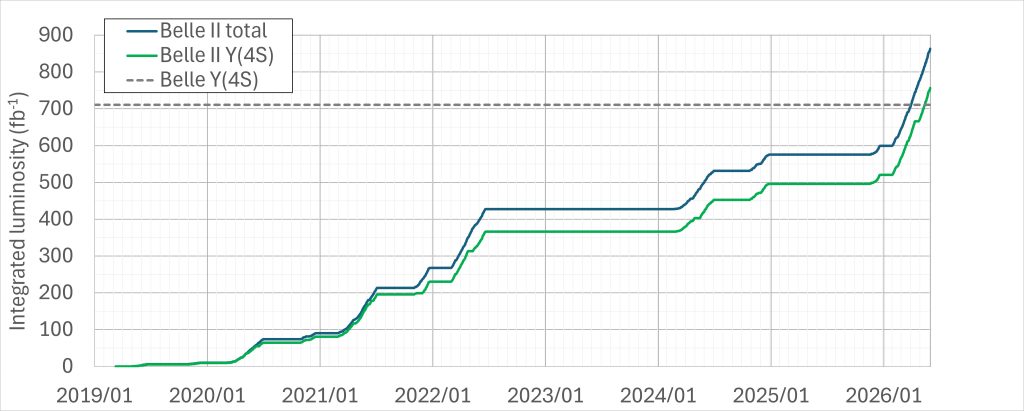
Through steady progress in the precise tuning of the accelerator, the experiment has achieved stable operation with a significantly higher luminosity than that of its predecessor, the Belle experiment at KEKB. Thanks to these continuous efforts, the dataset taken at the Υ(4S) energy to study B-meson decays has now exceeded the corresponding dataset of Belle and became the world largest.
Meaning
By acquiring this world-leading dataset, Belle II has cleared a pivotal milestone toward a new era—one that offers more precise measurements, leveraging the “cleanness” of electron-positron annihilations in the quest for new physics beyond the Standard Model.
Belle II has now accumulated the world’s largest Υ(4S) dataset, surpassing Belle! Leveraging the cleanness of B mesons produced from electron-positron annihilation at Υ(4S), this dataset opens the door to a new era in the quest for physics beyond the Standard Model.
About the Belle II Experiment
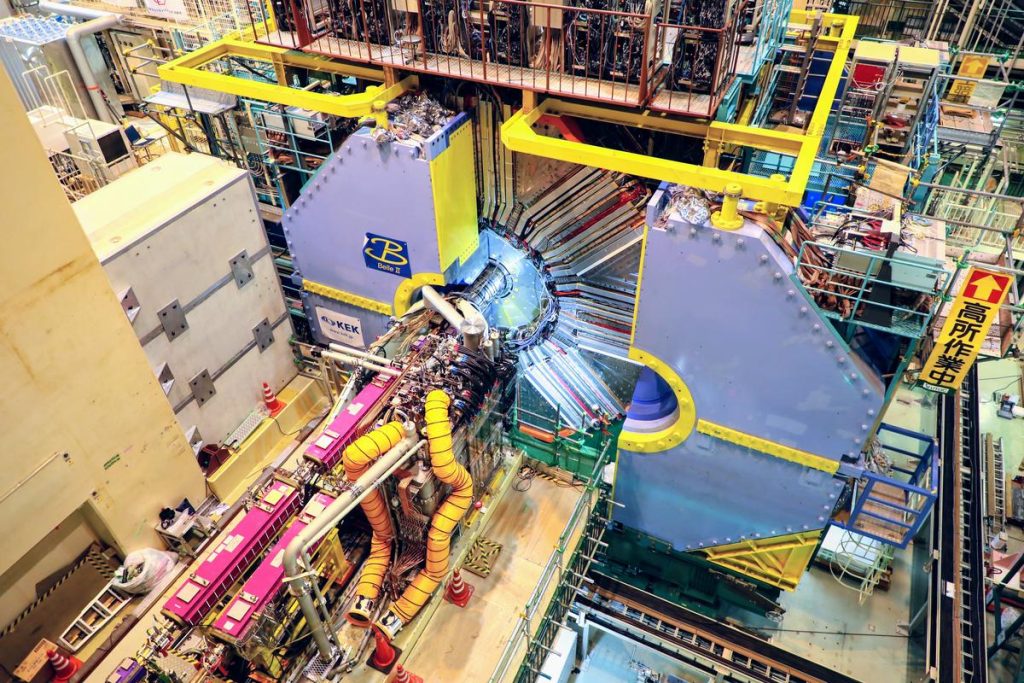
The Belle II experiment at the SuperKEKB electron-positron collider, KEK’s flagship project based at the Tsukuba campus, is a large-scale accelerator-based experiment to search for new physics beyond the Standard Model of elementary particles. The Belle II collaboration consists of more than 1,200 members from 28 countries and regions.
Belle II’s physics program pursues precision studies using decays of heavy quarks and leptons, a field known as “flavor physics,” and in particular searches for physics beyond the Standard Model through extremely rare and experimentally challenging processes. By comparing high-precision measurements with theoretical predictions, Belle II aims to uncover possible signs of new particles or forces beyond current theories.
In this physics program, a primary focus is placed on precision measurements of CP violation, lepton flavor universality violating processes, and rare phenomena in B-meson decays. SuperKEKB collides electrons and positrons at a center-of-mass energy of 10.58 GeV [Giga-electron-Volt] to generate Υ(4S) states, which immediately decay into B and anti-B meson pairs, and the subsequent B-meson decay events are recorded. To perform such studies, accumulating a vast amount of experimental B-meson data is indispensable.
The probability of a collision of particles is quantified by a metric called the “cross section.” The cross section for B-meson production at the Υ(4S) resonance is approximately 1 nb (nanobarn, where 1 nb=1,000,000 fb=10-33cm2). The collision performance is quantified by a metric known as “instantaneous luminosity” (or just “luminosity”); multiplying it by the cross section gives the number of events per second. Meanwhile, “integrated luminosity” is the time-integral of luminosity, reflecting the total data volume. Multiplying the integrated luminosity by the cross section yields the total number of events.
Higher instantaneous luminosity allows a faster accumulation of integrated luminosity. Higher integrated luminosity, and hence a larger number of events, allows physicists to study increasingly rare processes and to perform more precise measurements.
The predecessor, the Belle experiment, operated at the KEKB collider from 1999 to 2010 and recorded 772 million B-meson-pair events—the world’s largest experimental dataset at the time—corresponding to an integrated luminosity of 711 fb-1 (inverse-femto-barn) at the Υ(4S) resonance. Belle played a central role in establishing the Standard Model description of CP violation in the quark sector, leading to major breakthroughs in flavor physics and contributing to the 2008 Nobel Prize in Physics awarded to Makoto Kobayashi and Toshihide Maskawa.
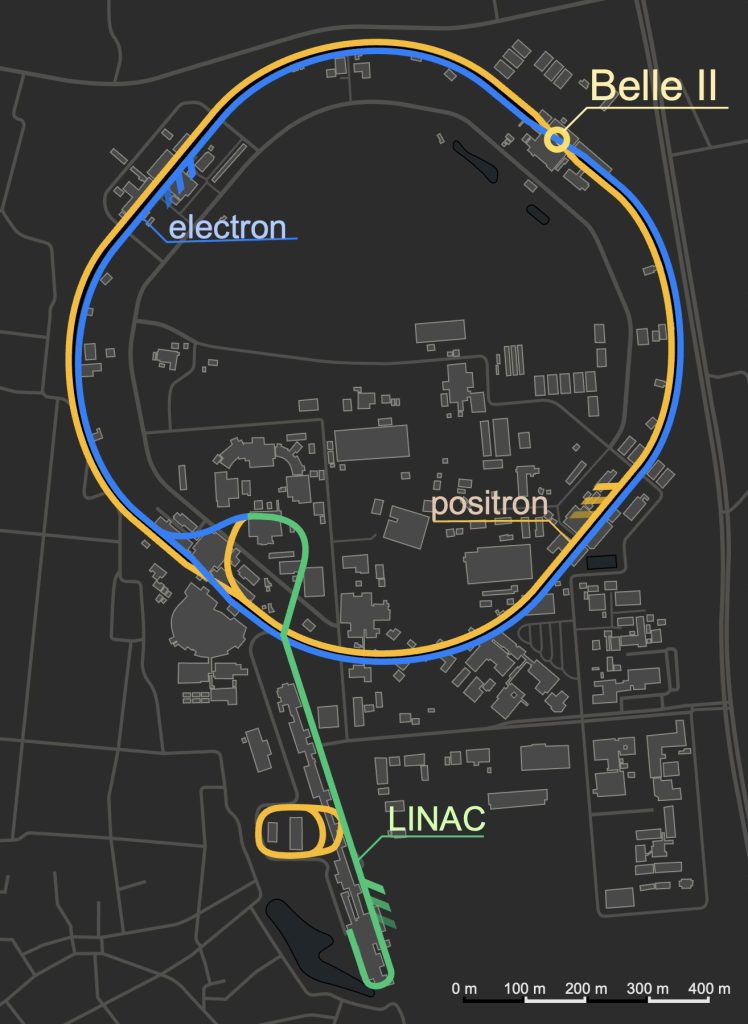
Similar to its predecessor KEKB, SuperKEKB accelerates electron and positron beams using a linear accelerator (LINAC), fills them into separate storage rings, and brings them to collide inside the Belle II detector. Based on this, it is designed to achieve the world’s highest luminosity through the novel “nano-beam” collision scheme, in which extremely small beam sizes at the interaction point yield a drastically high collision rate. SuperKEKB and Belle II have been in operation since 2019, aiming to accumulate high integrated luminosity and deliver groundbreaking physics results.
Key Achievements
The B-meson dataset accumulated by Belle II at the Υ(4S) became the world’s largest on May 17, surpassing that of the Belle experiment. As of June 4, the integrated luminosity at Υ(4S) has reached 757 fb−1. Together with additional datasets collected at energies different from that of Υ(4S), 86 fb-1 at 10.52 GeV and 19 fb-1 at and around 10.75 GeV, the total integrated luminosity of Belle II has reached 862 fb-1 and is still increasing.
To accumulate unprecedented amount of integrated luminosity, the SuperKEKB team and the Belle II collaboration have worked together and made steady efforts to precisely tune and operate the accelerator. Achieving high integrated luminosity requires stable accelerator operation at a high instantaneous luminosity. To increase instantaneous luminosity, it is necessary to produce high-intensity electron and positron beams with the linear accelerator, efficiently fill them into the storage rings, and precisely tune and control the beams in the storage rings. The stability has been limited by sudden beam loss phenomena, in which a fraction of the stored beam is lost with little or no precursor. These previously unknown challenges have been considerably resolved, enabling sustained operation near the new record instantaneous luminosity.
The new peak instantaneous luminosity, 5.2×1034 cm-2s-1, was recorded on March 19 this year, approximately 2.5 times the Belle record (cm-2s-1 means the number of collisions for one-square-centimeter cross-section reaction per second, the unit for instantaneous luminosity). Furthermore, data this year have been accumulated at an average rate of about three times faster than Belle’s best year.
Prospects
By acquiring the world-leading dataset, Belle II has cleared a pivotal milestone toward a new era. Detailed analyses of the accumulated dataset are expected to enable a series of searches that open the door to exciting physics discoveries.
The Belle II experiment features a “clean measurement” of B-mesons with no accompanying particles from electron-positron annihilation, enabling precise determination of the initial state of B-mesons. This allows, for example, highly efficient measurements of decay processes with final-state particles escaping detection (such as neutrinos), and inclusive measurements of B-meson decay processes with small theoretical uncertainties. Belle II’s strength is complementary to that of competitive experiments at CERN’s Large Hadron Collider (LHC), which achieve exceptional sensitivity to specific exclusive processes through very large production rates.
Current data taking at SuperKEKB and Belle II is scheduled to continue until the end of June and will resume following the summer break period. Belle II expects to reach the next milestone of a total integrated luminosity of 1 ab-1 (1000 fb-1) soon.
SuperKEKB and Belle II aim to ultimately accumulate 50 ab-1 of integrated luminosity, which is approximately 50 times that of Belle. To achieve this goal, continuous improvements in accelerator and detector performance will be pursued, including a planned upgrade of both the accelerator and the detector around 2032.
© Belle II Collaboration/KEK
produced by the electron-positron annihilation.
© KEK
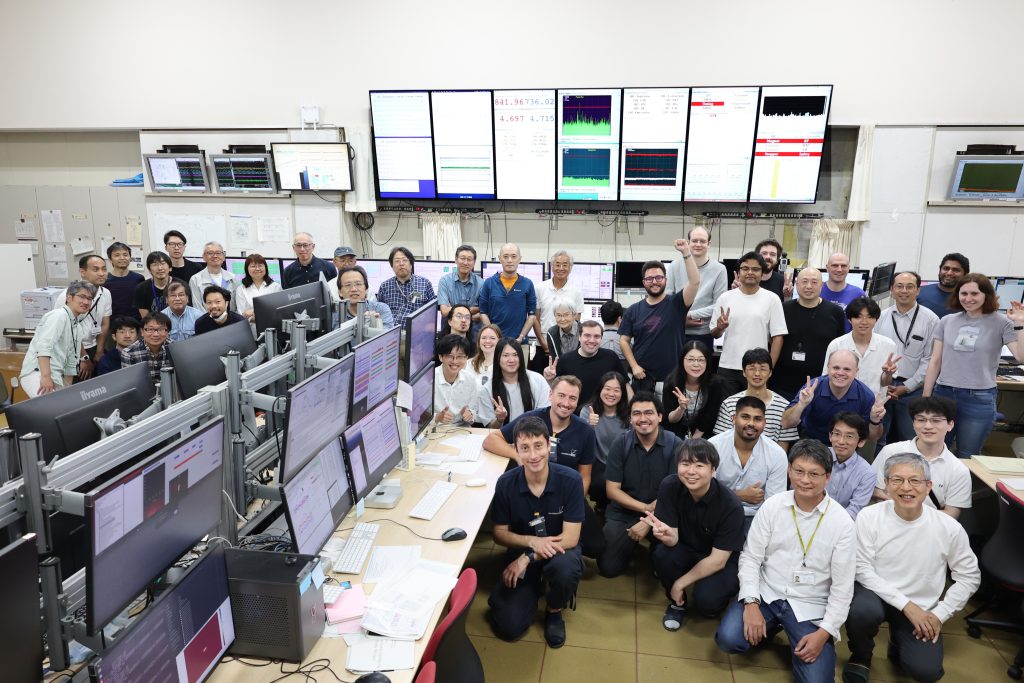
© Belle II Collaboration/KEK
From the Researchers

Dr Kenta Uno, KEK, Belle II Run Coordinator
Reaching and now surpassing the Belle dataset is an emotional and important moment for many of us. It reflects the strong collaboration between SuperKEKB and Belle II, as well as years of continuous effort by accelerator and detector experts across the collaboration since the experiment started in 2019. The whole journey has demonstrated how demanding operation at high luminosities can become, often requiring many people to respond around the clock to rapidly changing conditions. Nevertheless, the fact that we have reached this milestone while continuing to improve both machine and detector performance is something the collaboration can be very proud of.

Prof. Soeren Prell, Iowa State University, Belle II Physics Coordinator
Belle II has now accumulated the world’s largest Υ(4S) dataset produced in the clean environment of electron-positron collisions. This milestone marks the beginning of a new era of precision measurements and searches for new physics, placing Belle II in a unique position to study extremely rare processes that could reveal signs of physics beyond the Standard Model.

Prof. Florian Bernlochner, University of Bonn, Belle II spokesperson
The milestone represents both a symbolic transition and the beginning of a new precision era. Belle transformed flavor physics and established a tremendous scientific legacy. Surpassing the Belle Υ(4S) dataset marks the end of one chapter and the beginning of another. Belle II was designed not only to repeat Belle’s achievements, but to push far beyond them with substantially larger datasets and unprecedented precision. The fact that we are now entering this regime is a major moment for the collaboration and for the field.
Contact Information
<Research Contact>
High Energy Accelerator Research Organization (KEK)
Institute of Particle and Nuclear Studies (IPNS)
Prof. Mikihiko Nakao
Tel: 029-864-5200 ext. 4691
e-mail: mikihiko.nakao@kek.jp
<Press Contact>
High Energy Accelerator Research Organization (KEK)
Public Relations Office
Tel: 029-879-6047
e-mail: press@kek.jp